
Google I/O 2026
Gemini 3.5 Flash - Gemini Omni - Gemini Spark - Oh My!

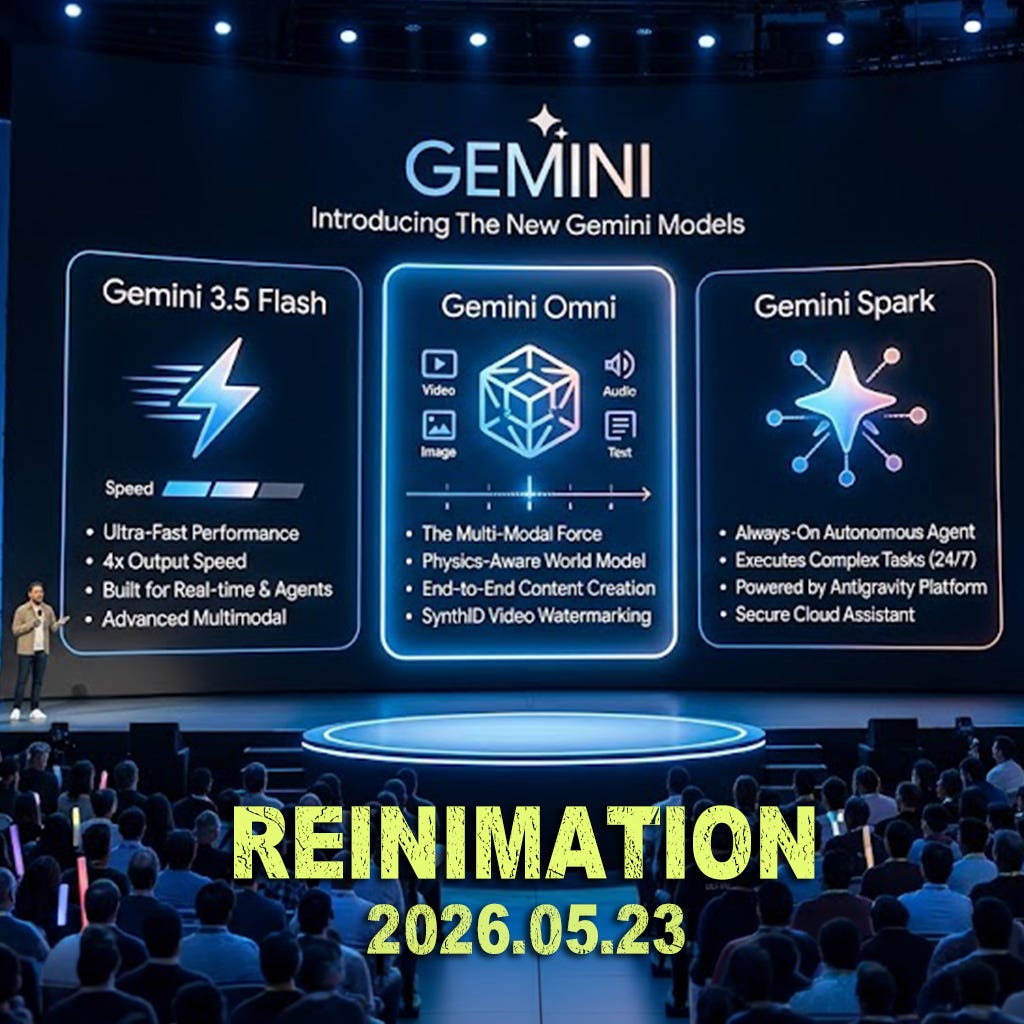
Republished from the Duke University Digital Media Community Blog
Google I/O 2026 just wrapped up, and the theme is clear: AI is moving from a passive chatbot that answers questions to an active partner that completes multi-step, long-horizon tasks.
Instead of general, incremental updates, Google unveiled a highly specialized trio of tools under the Gemini umbrella, each designed for a completely distinct role: Gemini 3.5 Flash, Gemini Omni, and Gemini Spark.
Here is exactly what changed and what these models do, stripped of the marketing buzzwords.
1. Gemini 3.5 Flash: Built for Speed and Execution
The core Gemini experience is getting a massive structural upgrade. Gemini 3.5 Flash is now the default model behind the Gemini app and Google Search’s “AI Mode.”
The focus here is combining pro-level intelligence with raw speed. According to Google, 3.5 Flash outputs tokens four times faster than other frontier models at its tier. More importantly, it is built specifically for “agentic” workflows—meaning it can handle multi-step tool use, coding, and logical planning without getting bogged down by latency.
The Benchmark Performance
To back up the performance claims, Google released several benchmark evaluations comparing the new model to its previous iteration:
Terminal-Bench 2.1: Reached 76.2% on coding agent tasks.
GDPval-AA: Achieved a 1,656 Elo rating for automated evaluation.
MCP Atlas: Hit 83.6% on multi-step tool handling.
CharXiv Reasoning: Scored 84.2% on advanced multimodal and visual understanding.
In practice, this means tasks that used to require a slower, flagship model—like analyzing massive data sheets or debugging code repositories—can now run via the lightweight Flash model at less than half the cost.
2. Gemini Omni: A Physics-Aware Video Engine
While Flash handles text, data, and code, Gemini Omni is Google’s new multimedia creation model. It functions as a “world model,” designed to understand and generate content across formats, starting heavily with video.
Unlike standard video generators that strictly translate text prompts into isolated pixels, Omni combines inputs from text, images, video, and audio references simultaneously. Google designed the model to understand fundamental real-world physics, including:
Kinetic energy and motion
Fluid dynamics
Gravity and structural weight
Because it understands these forces, the resulting video outputs look structurally realistic rather than dreamlike or warped. Furthermore, the generation process is conversational: you can generate a scene, and then use text prompts to swap camera angles, adjust the lighting style, or fix lip-sync drift directly.
Availability: The first version, Gemini Omni Flash, launched this week for Google AI Plus, Pro, and Ultra subscribers via the Gemini app and Google Flow, and is rolling out at no cost on YouTube Shorts and the YouTube Create app. All generated videos are automatically watermarked via Google’s SynthID technology for safety and verification.
3. Gemini Spark: The 24/7 Background Agent
Gemini Spark is arguably the most radical departure from traditional LLM assistants. Spark is an always-on, autonomous personal agent that runs in the cloud—meaning it continues executing tasks on your behalf even when your phone or laptop is completely powered off.
Built on the Google Antigravity platform, Spark links directly to your Google Workspace (Gmail, Docs, Calendar) and connects to third-party tools via the Model Context Protocol (MCP).
Key Capabilities & Security
Autonomous Tracking: It can monitor background tasks like apartment listings, product drops, or flight price fluctuations continuously and alert you when parameters change.
Daily Brief: Rolling out to Google AI subscribers (18+) in the U.S., this feature works overnight to analyze your inbox, calendar, and upcoming deadlines, presenting a concise, actionable digest when you wake up.
Agent Payments Protocol: While Spark will eventually be able to book services (like Uber or OpenTable) and buy items, it cannot spend money independently. Google built a specific security protocol requiring explicit user approval before any transaction is finalized.
Availability: Spark is currently in early testing with a Beta rolling out to Google AI Ultra subscribers in the U.S. next week, with broader feature expansions planned throughout the summer.
Primary Sources & Documentation
1. Model Performance & Technical Benchmarks
For the technical evaluation of Gemini 3.5 Flash, its 4x token speed increase, and specific scores regarding Terminal-Bench 2.1, GDPval-AA, MCP Atlas, and CharXiv Reasoning:
Source: Google Official Blog
Article: “Gemini 3.5: frontier intelligence with action” (Published May 19, 2026)
Reference URL: blog.google/innovation-and-ai/models-and-research/gemini-models/gemini-3-5/
2. Full Announcement Keynote Recap
For the complete catalog of feature rollouts, including Gemini Omni’s physics-aware capabilities, SynthID watermarking, YouTube Create/Shorts integration, and the Gemini Spark Beta deployment timeline on the Antigravity platform:
Source: Google Official Blog
Article: “100 things we announced at I/O 2026” (Published May 20, 2026)
Reference URL: blog.google/innovation-and-ai/technology/ai/google-io-2026-all-our-announcements/
3. Enterprise and Workspace Architecture
For details on how Gemini Spark integrates securely into Google Workspace, the Managed Agents API, and deployment via the Gemini Enterprise Agent Platform:
Source: Google Cloud Official Blog
Author: Thomas Kurian, CEO, Google Cloud
Article: “Innovations from Google I/O 26 on Google Cloud” (Published May 20, 2026)
Reference URL: cloud.google.com/blog/products/ai-machine-learning/innovations-from-google-io-26-on-google-cloud
4. Industry Analysis and Global Rollout Context
For context on API stable model identifiers (gemini-3.5-flash), token pricing structures ($1.50 per million input / $9.00 per million output), and the structural shift from thinking_budget to thinking_level parameters:
Source: Build Fast with AI
Article: “Google I/O 2026: Gemini 3.5 Flash, Spark & Agentic AI” (Published May 20, 2026)
Reference URL: buildfastwithai.com/blogs/google-io-2026-gemini-3-5-flash-announcements