
Lockdown
Even Jason Wears A Mask Sometimes

2026.01.24
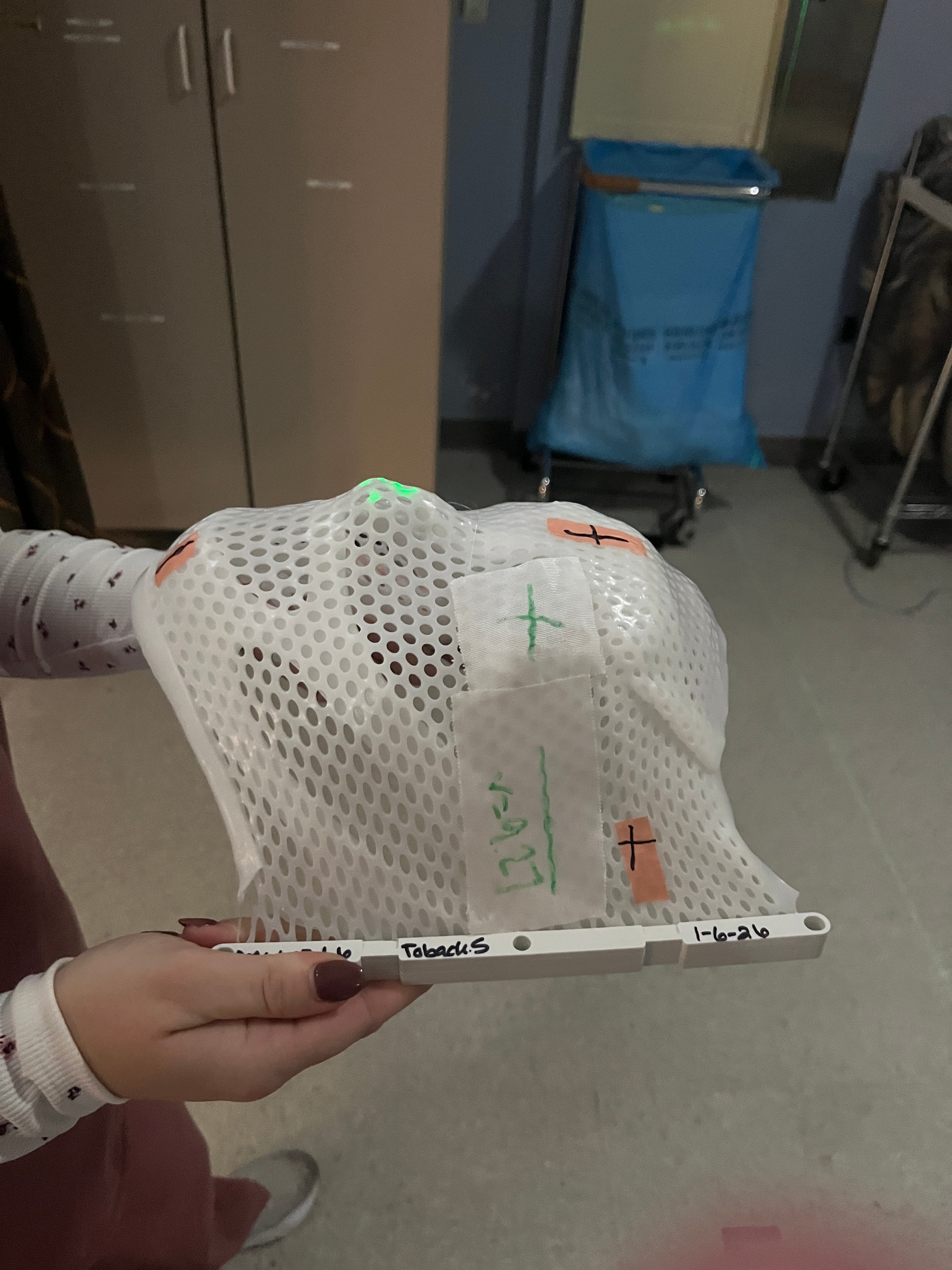
The rigid mesh mask used during radiation therapy looks medieval at first glance, but it’s the product of decades of refinement driven by a single requirement: precision. When radiation is being delivered to the brain, head and neck, millimeters matter. The mask’s job is not restraint for its own sake, but repeatability—holding the head in exactly the same position, every single session, over weeks of treatment.
Before modern immobilization systems, radiation positioning relied on far less exact methods. Early treatments used sandbags, foam wedges, bite blocks, tape, and hand-drawn skin marks. Patients were repositioned manually each day using room lasers and anatomical landmarks, which introduced small variations that accumulated over time. As radiation techniques became more targeted and higher-dose—especially with the rise of CT-guided planning and image-guided radiation therapy in the late twentieth century—those variations became unacceptable. Immobilization had to become reproducible, not just approximate.
The modern mesh mask emerged alongside these advances. Today’s masks are typically made from a thermoplastic polymer sheet with a perforated, lattice structure. At room temperature the material is rigid. When heated in a water bath, it becomes soft, pliable, and slightly elastic. The warm sheet is placed directly over the patient’s face and head while they lie on the treatment table, usually with a custom headrest underneath. Technicians gently mold the material to the contours of the skull, face, and jaw, ensuring firm contact without pressure points.
Although the mask begins to set within minutes, full hardening takes closer to thirty minutes. That extended stillness happens only once, during the initial fitting. Once cooled and fully hardened, the mask becomes a lightweight but unyielding shell. Daily treatment sessions themselves are much shorter—typically fifteen to twenty minutes—focused on accurate setup, verification, and delivery.
In some cases, a thin spacer—often around two millimeters—is intentionally introduced between the mask and the skin during molding. This creates a small, controlled buffer that improves comfort while preserving positional accuracy. The spacer becomes part of the system, ensuring the same fit, the same spacing, and the same geometry are reproduced every day.
Once formed, the mask locks into a fixed frame on the treatment table using standardized attachment points. This mechanical connection is critical—it means the mask doesn’t just fit the patient, it fits the machine. Every day, the same mask snaps into the same indexed position, aligning the head with the treatment coordinates established during planning.
The markings on the mask are part of that coordinate system. After the mask is created, a planning CT scan is performed with the patient wearing it. Radiation oncologists and medical physicists use that scan to define the exact target volume and beam geometry. Reference points from this digital plan are then transferred back to the physical world. Small ink marks are drawn directly on the mask, aligned with room lasers mounted on the walls and ceiling of the treatment vault. Those lasers intersect at the precise isocenter where the radiation beams converge. Each session begins by matching the mask’s marks to those lasers, often followed by onboard imaging to confirm alignment down to a millimeter or less.
As Patti Chapin, formerly a radiation therapist in the Radiation Medicine Department at Roswell Park Comprehensive Cancer Center, has explained, “The purpose of the mask is to hold your head and neck still and in exactly the right position during treatment… The mask is your friend. We will walk you through every step of the process to help ease your concerns and make you comfortable, while providing the most precise, accurate and comfortable experience.”
The result is a system that looks intimidating but exists to protect. By immobilizing what doesn’t need to move, clinicians can concentrate radiation where it’s needed and spare what isn’t. It’s a kind of lockdown—but one built from polymer, physics, and repetition rather than fear. And unlike the movies, this mask isn’t about trapping the person inside. It’s about making sure everything else stays exactly where it belongs.
#RadiationTherapy #CancerCare #MedicalTechnology #PrecisionMedicine #PatientExperience #BehindTheScenes #HealthcareDesign
Hannibal the New Cannibal!
Climb that mountain Stephen!